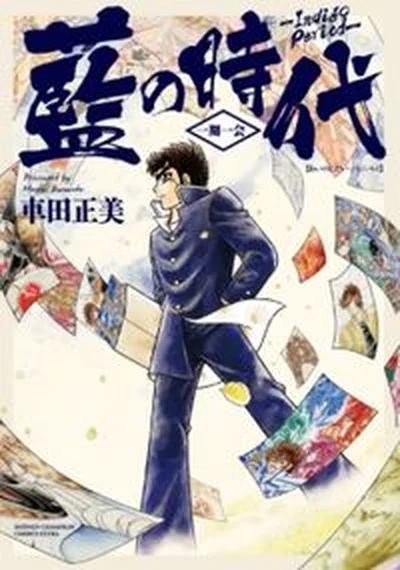
Masami Kurumada: Biography and Works
Mangaka behind Saint Seiya
Explore the career of Masami Kurumada and his mythological masterpiece Saint Seiya. Discover his hot-blooded shonen style, key works including Ring ni Kakero, and his lasting influence on 1980s manga.
Early Life and Artistic Development
Masami Kurumada was born on December 6, 1953, in Chuo, Tokyo, Japan. He grew up in postwar Tokyo during the rapid expansion of manga and weekly serialized comics, and his earliest artistic influences came from the boys’ adventure stories and sports manga that defined the 1960s. As a young man he was particularly drawn to boxing, the visual rhetoric of heroic poses, and the mythological imagery of classical antiquity — three preoccupations that would recur throughout his entire career.
Unlike many of his contemporaries, Kurumada did not come up through a long apprenticeship at an established mangaka’s studio. He developed his early technique largely on his own, drawing inspiration from the Showa-era heroic line of artists such as Mitsuteru Yokoyama and the dynamic action staging of Osamu Tezuka’s contemporaries. His first serious submission to Shueisha’s Weekly Shonen Jump came in 1974 with the one-shot Sukeban Arashi, which earned him an editor’s attention and a path into the magazine’s regular roster.
Professional Career and Breakthrough
Ring ni Kakero — The Hot-Blooded Foundation
Kurumada’s first major work was Ring ni Kakero (1977-1981), a boxing manga whose intensity and operatic staging made it a defining title of late-1970s Weekly Shonen Jump. The series followed Ryuji Takane and his sister Kiku as Ryuji rose through the brutal hierarchy of Japanese amateur boxing. Although the genre was conventional, Kurumada’s treatment was anything but: every blow was rendered as a planet-cracking event, every opponent introduced with the iconography of mythological heroes, and the panel composition prioritized monumental tableaux over realistic continuity.
The series won the 7th Kodansha Manga Award in 1983 and established the visual and emotional vocabulary that Kurumada would carry forward. The “hot-blooded” or nekketsu style of shonen action manga — protagonists bound by oaths to friends and family, escalating named techniques, opponents who become allies after defeat, and the recurring image of the warrior who refuses to fall — was effectively codified in Ring ni Kakero. Many of the structural devices that Saint Seiya would later make iconic, including the team of five fighters who travel together to face progressively stronger named opponents, originated here.
Fuma no Kojiro and the Transition
Between Ring ni Kakero and his masterpiece, Kurumada published Fuma no Kojiro (1982-1983), a ninja school action manga that introduced the Holy Sword Wars structure he would later adapt and expand. Fuma no Kojiro is the missing link between Kurumada’s early work and Saint Seiya: it features ten warriors with sacred weapons, a tournament structure organized by mystical principles, and a clear interest in arming young men with named weapons that grant supernatural power. The series was successful enough to receive an OVA adaptation but is best understood as the rehearsal for what came next.
Saint Seiya — The Mythological Masterpiece
In 1986 Kurumada began serializing Saint Seiya in Weekly Shonen Jump, and the series ran until 1990 across 28 tankōbon volumes. The premise — five young Bronze Saints, wearing constellation-themed armors called Cloths, fighting to protect the modern reincarnation of the goddess Athena — synthesized everything Kurumada had been developing. The Cloth-and-Cosmo system gave each warrior a discrete, named, collectible artifact; the Twelve Houses of the Zodiac gave him a tournament structure with mythological weight; and the gradual escalation from human Pope to Olympian gods gave the series a vertical cosmology that other shonen of the era rarely attempted.
Saint Seiya became an international phenomenon. The 1986 Toei anime adaptation became one of the defining anime exports of the late 1980s in Latin America, Spain, France and Italy, where it was broadcast as Los Caballeros del Zodiaco and Les Chevaliers du Zodiaque and remained a generational reference point well into the 21st century. The Bandai Cloth Myth toy line, launched in 2003 and still in continuous production, made the manga’s armor designs into one of the most lucrative ongoing collectible properties in anime merchandising.
Continuations and Later Work
After Saint Seiya concluded in 1990, Kurumada launched B’t X (1994-2000), a science-fiction action series with an iconography of biomechanical battle units that drew openly on his earlier visual vocabulary. Akane-iro no Kaze followed, along with several short-format works. In 2006 he returned to his masterpiece with Saint Seiya: Next Dimension, a sequel set immediately after the Hades arc that he has continued to publish irregularly through the present and considers the only canonical continuation of the original series.
Kurumada has remained creatively active across the spin-off ecosystem that grew around Saint Seiya. He has supervised or contributed to multiple projects including Saint Seiya: Episode G, The Lost Canvas, Saintia Sho, Saint Seiya Omega, the CG-animated Netflix production Knights of the Zodiac, and various theatrical and live-action adaptations. His role in these projects ranges from direct authorship to consultative supervision, but his preference for the original 28-volume cycle as the canonical text has remained consistent.
Artistic Style and Technique
Kurumada’s art is distinctive in a way that divides readers more than most mangaka of his generation. His linework is loose and gestural rather than tight and refined; his anatomical proportions deliberately exaggerate the heroic figure; his backgrounds are minimal in favor of monumental character close-ups; and his page composition prioritizes the visual impact of single tableaux over the continuity of the action between panels. Critics who fault his draftsmanship often miss that this looseness is a deliberate aesthetic choice rooted in the heroic-pose tradition of 1960s and 1970s Japanese boys’ adventure manga.
His treatment of armor is particularly notable. The Cloths in Saint Seiya are drawn with the precision of mythological objects rather than character costumes, with each piece — helmet, breastplate, gauntlets, greaves, shield — receiving distinct visual identity and the capacity to be displayed assembled or in pieces. This decision is what made the Bandai Cloth Myth figures possible and is a testament to Kurumada’s understanding that an iconic armor design must work as both a moving combat suit and a static collectible object.
The action staging itself is built around what Kurumada has called the “decisive blow” — the single-panel tableau in which a finishing technique is delivered, named, and visually amplified to mythological scale. Galaxian Explosion, Pegasus Ryuseiken, Aurora Execution and the rest of the Saint Seiya technique vocabulary work because Kurumada gives each one a defining visual signature that the reader can immediately recognize and a position in the page layout that gives it weight independent of the surrounding panels.
Key Achievements
- Created Saint Seiya, one of the foundational shonen action manga of the 1980s and one of the most internationally successful Japanese franchises of the 20th century
- Won the Kodansha Manga Award in 1983 for Ring ni Kakero, codifying the hot-blooded shonen action style
- Established the visual and structural template (collectible armors, tournament arcs, mythological vertical cosmology) that influenced four decades of subsequent shonen
- Designed armor systems that remain commercially viable as collectible toys more than three decades after the original publication
- Sustained a continuous creative relationship with the Saint Seiya franchise through Next Dimension and supervisory roles on multiple spin-offs and adaptations
Personal Life and Legacy
Kurumada has remained a relatively private figure throughout his career. He has spoken publicly about the influence of boxing, classical mythology, and Japanese heroic literature on his work, but has not cultivated the public profile of more media-friendly mangaka of his generation. He continues to live and work in the Tokyo area and remains actively involved in the Saint Seiya franchise’s ongoing development.
His relationship to the spin-offs his original work has spawned is unusual among manga creators. He has both authorized work he did not write — The Lost Canvas, Episode G, Saintia Sho — and explicitly disavowed adaptations he considered inconsistent with his vision, including the theatrical sequel Heaven Chapter — Overture. This dual role of guardian and continuator has shaped how the franchise has expanded over the past two decades.
Lasting Impact and Industry Influence
The structural innovations Kurumada brought to shonen manga in the 1970s and 1980s are now so standard that their origins are easy to overlook. The five-warrior team that travels together facing increasingly powerful opponents; the named finishing techniques that become collectible reader knowledge; the tournament arc as a fixed-sequence escalation; the use of mythological iconography as a vertical cosmology that can extend the power scale almost indefinitely — all of these are present in Saint Seiya and most of them were already present in Ring ni Kakero before that. They are now the load-bearing structures of dozens of subsequent shonen including Naruto, Bleach, Yu Yu Hakusho, Hunter x Hunter, and Jujutsu Kaisen.
His influence on collectible-armor and named-technique action manga is direct and acknowledged. Creators including Yoshiyuki Sadamoto, Hirohiko Araki, and the production teams behind the modern Toei action lineup have all cited Kurumada’s visual and structural vocabulary as a reference point. Outside Japan, his impact on the Latin American and Southern European fandoms is generational — for many readers in Spain, Mexico, Argentina, Brazil, France and Italy, Los Caballeros del Zodiaco was the first manga or anime they encountered, and Kurumada’s mythology continues to define what those readers expect from the medium.
Interesting Facts
- Kurumada based the structure of Saint Seiya explicitly on Greek mythology, with research drawn from the Iliad, the Odyssey, the Theogony of Hesiod, and Dante’s Inferno for the Hades arc cosmology
- Several of the named techniques in Saint Seiya were carried over with renamed equivalents from earlier works such as Ring ni Kakero and Fuma no Kojiro
- The character Pegasus Seiya was originally designed as a boxing-style protagonist before Kurumada redesigned him for the constellation-armor concept
- Kurumada has cited the iconic poses of professional wrestling as a direct visual influence on his depiction of combat tableaux
- The Asgard arc, often associated with Saint Seiya by anime audiences, is anime-original material developed by Toei in collaboration with Kurumada and does not appear in the manga
- He has been responsible for direct supervision of nearly every significant Saint Seiya spin-off, even those written by other authors
Frequently Asked Questions
When was Masami Kurumada born? Kurumada was born on December 6, 1953, in Chuo, Tokyo. He remains active as a manga creator and franchise supervisor.
What is Saint Seiya about? Saint Seiya follows five young Bronze Saints — Pegasus Seiya, Dragon Shiryu, Cygnus Hyoga, Andromeda Shun and Phoenix Ikki — who wear sacred armors called Cloths modeled on constellations and fight to protect the modern reincarnation of the goddess Athena across four major arcs (Galactic Tournament, Sanctuary, Poseidon, and Hades).
Why is Saint Seiya so important? Saint Seiya is one of the foundational shonen action manga of the 1980s. Its synthesis of Greek mythology, collectible armor design, and tournament-arc structure influenced almost every major shonen that followed, and its international anime broadcast made it a defining cultural reference for an entire generation of readers in Latin America, Spain, France and Italy.
What was Kurumada’s first major work? Ring ni Kakero (1977-1981), a boxing manga that won the Kodansha Manga Award in 1983 and codified the hot-blooded shonen action style that Kurumada would later refine into Saint Seiya.
Has Saint Seiya been adapted? Yes — extensively. The original Toei anime ran for 114 episodes from 1986 to 1989, the Hades arc was adapted in three OVA cycles between 2002 and 2008, and the franchise has produced multiple spin-off anime (Saint Seiya Omega, Soul of Gold, the Netflix CG Knights of the Zodiac), live-action film, theatrical features, and an extensive video game catalog.
Is Kurumada still actively writing manga? Yes. He continues to publish his sequel Saint Seiya: Next Dimension irregularly and supervises the broader franchise. He has not retired from active creative work.
What other manga has Kurumada written? Beyond Saint Seiya, his most significant works are Ring ni Kakero (boxing), Fuma no Kojiro (ninja action), B’t X (science-fiction action), and Akane-iro no Kaze. He has also produced shorter works and contributed to the supervision of multiple Saint Seiya spin-offs.
Who influenced Kurumada’s style? Kurumada has cited the heroic-pose tradition of late-1960s and 1970s shonen manga, classical Greek mythology, professional boxing, and professional wrestling as primary influences on his visual vocabulary and structural choices.
What is Kurumada’s relationship to the Saint Seiya spin-offs? He authorizes most of them and considers Saint Seiya: Next Dimension, his own continuation, the only fully canonical sequel to the original 28-volume manga. He has explicitly disavowed certain adaptations including the theatrical Heaven Chapter — Overture when he considered them inconsistent with his vision.
How did Saint Seiya become so popular outside Japan? The Toei anime adaptation was sold internationally in the late 1980s and broadcast across Latin America, Spain, France and Italy under localized titles such as Los Caballeros del Zodiaco. It became a generational reference for readers and viewers in those markets, and the Bandai Cloth Myth toy line has sustained the franchise’s commercial relevance globally since 2003.
Masami Kurumada stands as one of the architects of modern shonen action manga. Through Ring ni Kakero, Fuma no Kojiro, and above all Saint Seiya, he codified the structural and visual vocabulary that the genre has been building on for nearly four decades. His mythological cosmology, his collectible armor designs, and his commitment to the monumental action tableau continue to shape how shonen storytelling is read, drawn, and adapted around the world.
Frequently asked questions about Masami Kurumada
Sources and editorial review
Editorial review: Doni Hernandez. Sourcing and corrections policy. Report an error.
Other Mangakas You May Like
All mangakas
Akira Toriyama
Explore Akira Toriyama’s manga and character design. Distinguish Dragon Ball from its adaptations and find a starting point for his work.
Notable Works:
- • Dragon Ball
- • Dr. Slump
- + 2 more
Eiichiro Oda
Meet Eiichiro Oda, creator of One Piece. Follow verified career milestones and learn what to look for when reading his work.
Notable Works:
- • One Piece
- • Wanted!