Death Note

A cat-and-mouse game between a genius teenager with a god-like notebook and a brilliant detective determined to stop him.

Death Note manga — Psychological Thriller by Tsugumi Ohba (Writer), Takeshi Obata (Artist)

All Death Note Story Arcs in Order

# Arc
1 L Arc
2 Yotsuba Arc
3 Mello & Near Arc
4 New World Arc
5 Wammy's House Arc
6 Shinigami Realm Arc
7 Task Force Formation Arc
8 Final Confrontation Arc

Overview

Death Note is the cat-and-mouse psychological thriller that, more than any other manga of the 2000s, demonstrated that a serialized weekly comic could sustain the intellectual tension of a chess match for over 100 chapters without losing tempo. Created by writer Tsugumi Ohba and artist Takeshi Obata, the series was serialized in Weekly Shōnen Jump from December 2003 to May 2006 across 108 chapters and 12 tankōbon volumes — a deliberately compact, structurally complete narrative in an industry that overwhelmingly rewards open-ended runs.

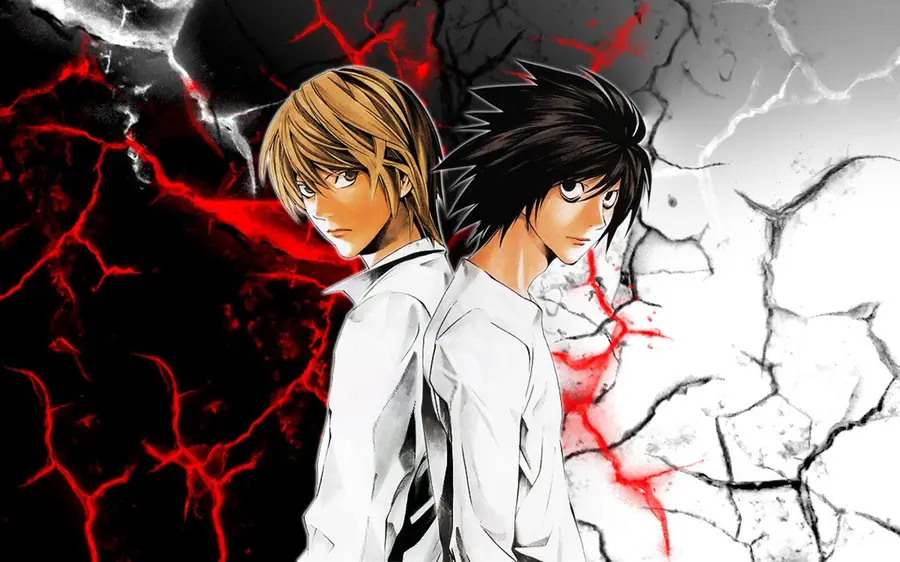
The series follows Light Yagami, a brilliant high-school student in modern Tokyo who finds a supernatural notebook dropped by the bored shinigami Ryuk. The notebook’s rule is simple and absolute: write a person’s name in it while picturing their face, and that person dies of a heart attack within forty seconds. Light, convinced that he can use this power to cleanse the world of criminals and reshape it into a utopia under his own moral leadership, adopts the alias “Kira” and begins systematic killings. The world’s greatest detective, known only as L, takes the case — and the series becomes a sustained intellectual duel between two of the most carefully constructed antagonists in modern manga.

What Is Death Note About?

The opening premise is rendered with unusual economy. In the first chapter Light, an honor student so academically dominant that his teachers and classmates regard him as an alien presence, watches a black notebook fall from the sky into the Daikoku Private Academy courtyard. He picks it up. The cover reads DEATH NOTE in English, and the inside cover lists the rules: the human whose name is written in this note shall die. The user must have the subject’s face in mind when writing. The default cause of death is heart attack, but specific causes can be specified if written within forty seconds of the name.

Light tests the notebook on a hostage-taker he sees on the news. The man dies. He tests it on a violent stalker assaulting a stranger in the street. The stalker dies. With two confirmations Light commits to the project the rest of the series will track: the systematic elimination of every criminal whose name and face he can identify, beginning with Japanese fugitives and expanding to international death-row inmates whose extraditions stall in court. He is helped, watched, and tormented by Ryuk — the shinigami who dropped the notebook out of boredom and who sees the entire enterprise as entertainment.

What follows across twelve volumes is the slow construction and dismantling of Kira’s regime. The world’s greatest detective, an eccentric figure known only as L, traces the killings to the Kanto region of Japan and then to Light specifically without being able to prove it. The first half of the series is the cat-and-mouse between Light and L. The second half, after L’s death at the end of volume 7, is the cat-and-mouse between Light and L’s two designated successors — Near and Mello — both of whom were raised at L’s hidden orphanage Wammy’s House. The series concludes in volume 12 with Light’s exposure and death, the precise mechanics of which Ohba constructs as a single material substitution that renders Light’s entire sustained operation functionally meaningless in seconds.

Reading Order

The manga can be read straightforwardly in tankōbon order across 12 volumes. Unlike the open-ended shōnen serializations that dominated the 2000s, Death Note is a structurally closed narrative with a single integrated plot and no spin-off arcs that interrupt the main story. Every chapter advances the central conflict; there are no episodic detours, no power-up sequences, no tournament arcs. The compact length is deliberate — Ohba has said in interviews that the series was always planned to end with Light’s death and that the post-L second arc was the structural movement he was preparing from the first chapter.

Several supplementary materials exist for readers who want to extend the experience. The one-shot “Death Note: Special: C-Kira Story” published in 2008 in Weekly Shōnen Jump is set after the main series and depicts Near’s response to a copycat Kira. The ten-chapter sequel one-shot “Death Note: Special: a-Kira Story” published in 2020 is set fourteen years after the original and was the most-read chapter of Weekly Shōnen Jump that year. Neither is required for the main story but both extend the cosmology in interesting ways. The light novel Death Note Another Note: The Los Angeles BB Murder Cases by Nisio Isin (2006) is a prequel set during one of L’s earlier investigations and is the most substantial supplementary text.

For readers who want to start with the anime adaptation, the Madhouse production from 2006-2007 covers the manga in 37 episodes with high fidelity through Light’s death and a slightly compressed handling of the Mello/Near arc. The four Japanese live-action films (2006, 2008, 2016) compress the timeline aggressively but capture the central psychological dynamic; the 2017 Netflix adaptation departs from the source material extensively and is generally regarded as the weakest entry in the franchise.

What Makes Death Note Important

Death Note is one of the foundational works of 2000s shōnen and one of the most internationally successful Japanese manga properties of its decade. The series sold over 30 million tankōbon copies worldwide, was translated into more than thirty languages, and won the 2006 Shogakukan Manga Award in the shōnen category. By the close of the 2010s it had been adapted into anime, four live-action Japanese films, a Netflix US film, a Japanese television drama, multiple stage plays in Japan and abroad, video games on Nintendo DS, and one of the most successful Japanese theatrical musical productions of the 2010s.

Its specific contribution to the medium was the demonstration that the psychological thriller — historically a difficult genre to sustain in serialized comic form — could anchor a major shōnen weekly serialization. Where competing series of the period (Naruto, Bleach, One Piece) were built around episodic action and character roster expansion, Death Note was built around sustained logical confrontation. The cat-and-mouse structure between Light and L became a template that subsequent series including Code Geass, Future Diary, and the more recent The Promised Neverland would explicitly build on.

The series has also been one of the most influential modern works in shaping the international audience’s expectations of what shōnen could do tonally. Before Death Note, the international perception of shōnen was overwhelmingly action-oriented; after it, the perception expanded to include the possibility of intellectually demanding narrative without conventional combat. The Madhouse anime adaptation, broadcast internationally on Adult Swim and Netflix among other channels, was for many international viewers their first exposure to a manga property treated as serious narrative fiction rather than children’s entertainment.

Why This Manga Stands Out

Beyond its commercial position, the manga rewards close reading on its own terms. Obata’s art is one of the technically most refined linework styles in modern manga — a high-contrast, photorealistic register that gives every page the visual weight of a graphic novel rather than a weekly serialization. His character designs are precise enough that L’s iconic seated posture (knees pulled to chest, thumb to mouth, black-circled eyes) has become one of the most-recognized character silhouettes in modern anime. His Light Yagami evolves visually across the series in a way that tracks the character’s internal corruption — by volume 12 the same face that opened the series as the model honor student looks visibly different, and the difference is constructed through a hundred small choices in line weight and shadow rather than dramatic redesign.

The series’ emotional weight comes from Ohba’s commitment to making both Light and L psychologically coherent rather than ideologically convenient. Light is genuinely intelligent, genuinely capable of moral reasoning, and genuinely persuasive when articulating his vision; L is genuinely conflicted about the methods his pursuit requires. Neither character is a strawman. The Death Note system itself is treated with rigor — the rules are fixed, the limitations are honored, and the series’ major plot turns repeatedly hinge on careful reasoning about exactly what the notebook can and cannot do rather than on convenient new rule-revelations.

The series is also unusual among major shōnen for the structural completeness of its ending. Light dies. The Death Note returns to the shinigami realm. Ryuk, who has been the silent observer of the entire enterprise, writes Light’s name in his own notebook and walks away. There is no ambiguous conclusion, no franchise hook, no second-generation continuation that gradually undercuts the original arc. The series ends because the story Ohba was telling concludes, and the franchise material that has appeared since (the C-Kira and a-Kira one-shots, the various adaptations) has consistently respected this structural completeness.

Publication and Adaptations

Death Note was serialized in Weekly Shōnen Jump from December 2003 to May 2006 and collected in 12 tankōbon volumes by Shueisha, with subsequent re-releases in three-volume Black Edition omnibuses, a single all-in-one edition, and various international print formats. The series is published in English by Viz Media (12-volume tankōbon and 6-volume Black Edition), in Spanish by Glénat / Editorial Norma in different markets, in French by Kana, and in Italian by Planet Manga, with translations into more than thirty languages worldwide.

The Madhouse anime adaptation aired in Japan from October 2006 to June 2007 across 37 episodes, directed by Tetsurō Araki and produced by VAP, Konami and Nippon Television. The adaptation is widely considered one of the most faithful long-form anime productions of the 2000s and helped establish Madhouse’s reputation for psychologically dense adult-oriented anime that the studio would build on with later projects including Monster and One-Punch Man Season 1. The English dub by Madhouse subsidiary Lazy English Dubbing remains one of the most-praised English manga-anime adaptations of its era.

The franchise has continued to expand across formats. The four Japanese live-action films directed by Shusuke Kaneko (2006), Hideo Nakata (2008), and Shinsuke Sato (2016) compressed the timeline and made Light’s character significantly less unsympathetic than in the source material. The 2017 Netflix US adaptation directed by Adam Wingard relocated the narrative to Seattle and adopted a substantially different characterization for Light Turner; the adaptation was generally received negatively by fans of the original. The Japanese musical adaptation, with music by Frank Wildhorn (best known for Jekyll & Hyde), has been one of the most successful Japanese theatrical musical exports of the 2010s and has been staged in Japan, Korea, China, and Russia.

Readers drawn to Death Note’s combination of intellectual confrontation and supernatural premise will find immediate companions in Monster, Naoki Urasawa’s psychological thriller about a doctor pursuing a serial killer across Eastern Europe, and in 20th Century Boys, Urasawa’s apocalyptic mystery about childhood friends rediscovering a buried conspiracy. For readers more interested in the cat-and-mouse detective-versus-criminal architecture, Detective Conan operates in the same broad tradition with a different tonal register and a vastly longer serialization. Among Ohba and Obata’s own collaborations, Bakuman — their 2008-2012 follow-up about two teenagers trying to break into the manga industry — is structurally completely different but shares the same writer-artist partnership and many of the same compositional sensibilities.

Frequently Asked Questions

Is Death Note finished?

Yes. Death Note is a structurally complete series that concluded in May 2006 across 12 tankōbon volumes. Two short sequel one-shots have been published since (C-Kira Story in 2008 and a-Kira Story in 2020), but neither extends the main narrative — they are short epilogues set after the original’s conclusion.

How many volumes does Death Note have?

The manga has 12 tankōbon volumes (108 chapters). It has also been re-released in 6 Black Edition omnibus volumes, a single All-in-One Edition, and various international formats including Viz Media’s 12-volume English release.

Is there an anime adaptation?

Yes. The Madhouse anime adaptation, directed by Tetsurō Araki, aired from October 2006 to June 2007 across 37 episodes and is widely considered one of the most faithful long-form anime adaptations of the 2000s. The franchise has also produced four Japanese live-action films, a Netflix US film, a Japanese television drama, a successful theatrical musical, and multiple video games.

What age rating is Death Note?

Death Note is rated 16+ (Older Teen) in most markets. The series features sustained psychological tension, mass killings depicted on-page, complex moral ambiguity, and explicit philosophical engagement with themes of justice, power, and authoritarianism. It is closer in tone to Monster than to mainstream shōnen action titles like My Hero Academia or Demon Slayer.

Where can I buy Death Note manga?

The manga is published in English by Viz Media in both 12-volume tankōbon and 6-volume Black Edition formats. Spanish editions are available through Glénat and Editorial Norma; French through Kana; Italian through Planet Manga. Print and digital editions are widely available through Amazon and major retailers worldwide.

Death Note Arc Guides

#1

L Arc

Light Yagami discovers a supernatural notebook dropped by Ryuk the death god that allows him to kill anyone by writing their name. Intoxicated by god-like power, Light begins eliminating criminals under the alias Kira, establishing himself as justice figure. The world's greatest detective, known only as L, begins investigating the mysterious murders, initiating psychological battle between two geniuses.

#2

Yotsuba Arc

Light undergoes investigation while under official custody. The Yotsuba Group becomes center of investigation when employees display suspicious death patterns, revealing other Death Note users exist. Multiple Death Note users pursuing independent agendas complicate the investigation and Light's assumed monopoly on the notebook's power.

#3

Mello & Near Arc

L's successors Near and Mello take over investigation as L's health deteriorates. Near inherits the investigation through official channels while Mello pursues aggressive unorthodox methods working with criminal organizations. The dual investigation approach applies increasing pressure to Light as parallel investigations converge toward identifying the truth.

#4

New World Arc

Kira's true identity becomes publicly known and the investigation culminates as Light's concealment ends. Light's position shifts from hidden god figure to openly acknowledged individual with supernatural power. The final investigation phase demonstrates that sustained evidence collection eventually overcomes deception regardless of sophistication.

#5

Wammy's House Arc

The orphanage that produced L and his successors is revealed, explaining how exceptional investigators develop despite lacking formal law enforcement training. The orphanage's screening and educational methodology identifies talented children and cultivates their deductive reasoning through competitive environment and superior education.

#6

Shinigami Realm Arc

The supernatural beings inhabiting alternate dimension parallel to human world are explored through world-building exposition. Shinigami are death gods neither inherently good nor evil, occupying role as supernatural observers of human affairs. The realm's physical characteristics, social organization, and rules governing shinigami behavior establish coherent supernatural system.

#7

Task Force Formation Arc

The Japanese police investigation structure responding to Kira murders is established as official government response. The task force combines high-ranking police officers with investigative expertise, creating official authority base for the investigation through institutional framework.

#8

Final Confrontation Arc

The series' ultimate conflict culminates as investigation forces Light into final confrontation with accumulated evidence and coordinated opposition forces. Light's psychological collapse demonstrates that supernatural power ultimately proves insufficient against coordinated human effort and systematic investigation.

Death Note Merchandise

Read manga free with Amazon Prime

30-day free trial: free shipping, Prime Reading, Kindle, Prime Video and more.

Try Prime free

Affiliate link. 30-day free trial for new members. Then $14.99/month — cancel anytime.

FAQ: Death Note

You May Also Like

All manga