Dr. Stone
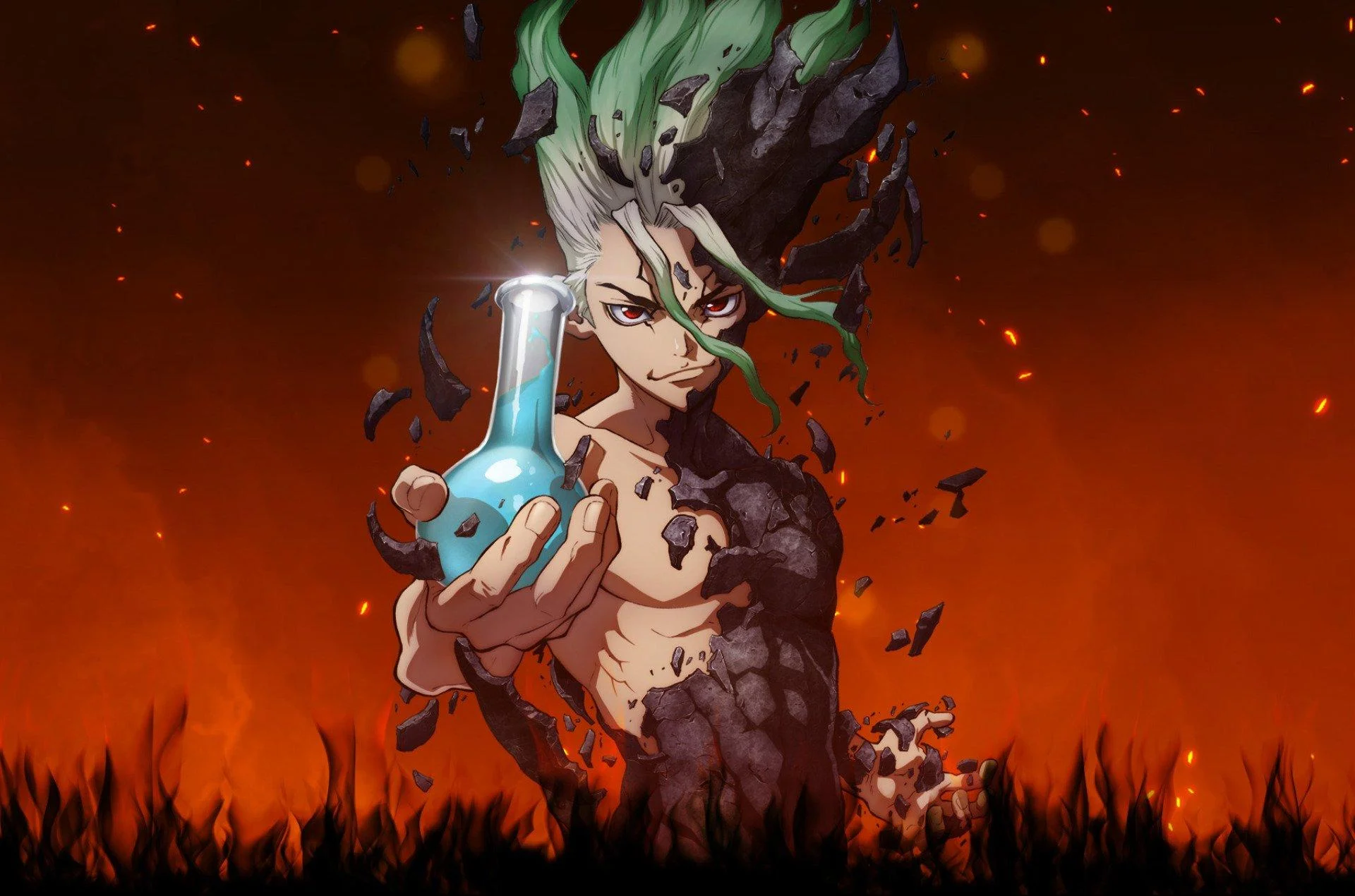
Completed sci-fi shonen: teen genius Senku Ishigami rebuilds civilization from scratch after 3,700 years of global petrification. Science vs. brute force.
All Dr. Stone Story Arcs in Order
| # | Arc |
|---|---|
| 1 | Stone World — Kingdom of Science |
| 2 | Stone Wars — Vs. Tsukasa Empire |
| 3 | Treasure Island — Vs. Petrification Kingdom |
| 4 | New America City — The Science Frontier |
| 5 | New World — Moon Mission |
What is Dr. Stone?
Dr. Stone is a science-fiction shonen manga written by Riichiro Inagaki and illustrated by Boichi, serialized in Weekly Shōnen Jump from 2017 to 2022. The series spans 26 volumes and 232 chapters, presenting a completed story that follows teenage genius Senku Ishigami’s systematic reconstruction of human civilization after a mysterious event turns every person on Earth to stone.
The series is exceptional within shonen manga for its genuine scientific content. Every technology Senku develops — from basic chemistry to radio communication to spaceflight — is rooted in real scientific principles explained accurately enough to function as informal science education. The manga has been praised by educators and scientists for making chemistry, physics, and engineering exciting without sacrificing accuracy.
The Science Behind the Story
Dr. Stone’s narrative engine is the cascade of scientific development. Each technology Senku builds requires prerequisites: making glass requires sand and fire; making vacuum tubes requires glass; making radio requires vacuum tubes. This industrial dependency chain creates organic dramatic tension — readers understand intuitively that skipping steps is impossible, making each achievement feel genuinely earned.
Boichi’s artwork translates complex scientific processes into visually engaging sequences. Chemical reactions, mechanical engineering, and physical phenomena are drawn with technical precision and visual dynamism that communicate both the beauty and the logic of scientific processes. The series makes abstract scientific knowledge concrete and achievable, arguing implicitly that science is not magic performed by exceptional people but systematic thinking available to anyone willing to apply it.
Stone World and the Human Condition
The petrification premise strips civilization to its foundations, asking what remains when all accumulated infrastructure disappears. Dr. Stone’s answer is consistent: human knowledge, preserved in memory and transmitted through teaching, is civilization’s irreducible core. Buildings can be rebuilt, machines can be reconstructed, but the knowledge of how to build and reconstruct is the actual resource.
This argument has practical implications within the narrative — Tsukasa’s ideology of selective revival destroys knowledge along with people, creating a genuinely impoverished civilization regardless of how clean its moral foundation appears. Senku’s insistence on reviving everyone reflects his understanding that civilization requires diverse expertise, and that you cannot predict in advance which person carries which critical knowledge.
Tsukasa and Ideological Conflict
The series’ most sophisticated element is its treatment of Tsukasa Shishio’s ideology. Tsukasa is not presented as simply wrong — his critique of the old world’s corruption and inequality has genuine validity. The series acknowledges that the civilization Senku wants to rebuild included exploitation, systemic injustice, and concentrated power. Tsukasa’s question — why rebuild that? — deserves a real answer, not dismissal.
Senku’s answer is procedural rather than ideological: scientific civilization produces material conditions that make life longer, less painful, and more free. The argument is not that the old world was good but that the method for improving it is through development rather than selective elimination. This exchange between two characters who both want human flourishing but disagree fundamentally about how to achieve it is the series’ most mature contribution to shonen manga’s philosophical tradition.
Chrome and the Democratization of Science
Chrome’s character arc carries the series’ most important implicit argument: that scientific thinking is natural to human beings, not the exclusive property of trained experts. Chrome independently discovered basic chemistry through curiosity and experimentation — the same process that produced formal scientific knowledge in the historical old world. His achievement suggests that science is not a body of content to be memorized but a method of engaging with the world that anyone can practice.
This democratization extends to the Kingdom of Science’s structure. Senku never hoards knowledge — he teaches immediately and completely, because the distributed knowledge base is stronger than any individual monopoly. The Kingdom of Science works because scientific knowledge is freely shared, creating a civilization where any member can contribute improvements and innovations.
Artistic Excellence and Scientific Visualization
Boichi’s art in Dr. Stone is technically extraordinary. The detailed mechanical and chemical diagrams are accurate enough to explain actual processes while remaining visually compelling. Action sequences possess kinetic energy and spatial clarity. Character designs, particularly Senku’s distinctive green-streaked hair and his constant intense focus, create immediately iconic visual identities.
The series’ visual treatment of the Stone World — vast landscapes of petrified humans covered in centuries of moss and plant growth — creates an atmosphere simultaneously beautiful and melancholy. The stone statues are not horror imagery but monuments, evidence of the civilization that existed and the work required to restore it. Boichi transforms scientific diagrams, industrial processes, and geological formations into genuinely beautiful artwork, arguing implicitly that science itself has aesthetic dimensions.
Legacy and Influence
Dr. Stone demonstrated that science-focused storytelling could achieve mainstream shonen success without sacrificing engagement. The series generated significant educational interest — teachers and science communicators used it as a reference point for introducing students to chemistry and physics. Its treatment of Senku as a protagonist whose superpower is literally scientific knowledge challenged conventional assumptions about what shonen manga heroes could be.
The completed narrative arc — beginning with primitive stone-breaking and ending with a moon mission — demonstrated ambitious scope delivered within a reasonable page count. Unlike many long-running series, Dr. Stone maintained consistent narrative momentum and reached a conclusion that fulfilled its central premise: could science, applied systematically and collaboratively, rebuild civilization within a single generation? The answer, the series argues, is yes.
The New World Arc: From Ocean to Moon
The final arc of Dr. Stone is the series’ most ambitious test of its central premise at maximum scale. Senku’s goal was never merely to rebuild Ishigami Village — it was to revive all 7 billion petrified humans and restore global civilization. The New World arc forces this ambition to confront its hardest practical obstacle: the source of the petrification beam is on the moon, and reaching it requires aerospace engineering capability that no ground-based civilization in the Stone World currently possesses.
The solution is characteristically Senku: build every prerequisite, systematically. The Perseus expedition gathers materials and expertise across continents. The encounter with Dr. Xeno’s North American civilization adds competitive pressure that accelerates development and eventually transitions into collaboration — the series’ most direct statement that rival civilizations united toward shared purpose outperform either civilization working alone. The moon rocket is constructed through the combined technical knowledge of both factions, with Xeno’s aerospace specialization filling gaps that Senku’s own knowledge base lacked.
The moon mission sequence is among the most technically detailed and visually spectacular in the series. Boichi’s artwork captures the genuine terror and wonder of spaceflight — the fragility of the vehicle, the absolute silence of space, Earth visible as a small sphere below the viewport. The emotional weight of the sequence comes from understanding how improbable it is: a small group of people, starting with nothing but knowledge and stone tools, built their way to the moon in under two decades. The distance between the series’ opening image and its conclusion is a direct measure of what systematic scientific thinking can accomplish.
The resolution of the Why-Man mystery provides an answer that is simultaneously surprising and thematically coherent. The universe in Dr. Stone operates according to discoverable rules — the petrification mechanism is not supernatural but physical, and the explanation honors the series’ commitment to scientific grounding throughout. Dr. Stone ends not with a battle but with a discovery, repeating the genre choice that defined it from its first chapter.
Frequently Asked Questions
Is Dr. Stone finished?
Yes, Dr. Stone is a completed manga series. The story concluded in March 2022 with chapter 232, reaching a definitive ending that resolved the central petrification mystery. Readers can experience the complete narrative across 26 volumes, including the series’ ambitious conclusion on the moon.
How many volumes does Dr. Stone have?
Dr. Stone spans 26 volumes total. The series ran for 232 chapters in Weekly Shōnen Jump from 2017 to 2022, telling a complete story from the Stone World’s beginning to the resolution of the Why-Man mystery and the global revival of humanity.
Is the science in Dr. Stone accurate?
Yes, Dr. Stone’s scientific content is grounded in real chemistry, physics, and engineering principles. While some processes are simplified for narrative pacing, the fundamental science is accurate — the series has been praised by educators for making complex scientific concepts accessible and engaging. The production of nitric acid, glassmaking, radio transmission, and rocket propulsion are all based on real processes.
Does Dr. Stone have an anime adaptation?
Yes, Dr. Stone has a complete anime adaptation produced by TMS Entertainment and Lidenfilms. The anime spans three seasons: Season 1 (24 episodes, 2019), Stone Wars / Season 2 (11 episodes, 2021), and New World / Season 3 (22 episodes, 2023). The adaptation covers the complete manga story with high-quality animation.
Where can I buy Dr. Stone manga in English?
Dr. Stone is widely available in English through major retailers including Amazon, Barnes & Noble, and independent bookstores. Viz Media publishes the English edition. Digital versions are available through ComiXology, Kindle, and Viz Media’s own digital platform. Complete box sets are available for readers who prefer collecting the full series at once.
What age rating is Dr. Stone?
Dr. Stone is appropriate for readers 13 and up. The series contains action violence and some moderately intense sequences, but the scientific focus and overall optimistic tone make it more accessible than many contemporary action manga. The series is often recommended as an entry point for new manga readers due to its engaging premise and educational content.
Dr. Stone Arc Guides
Stone World — Kingdom of Science
A mysterious green light petrifies all of humanity simultaneously. Thousands of years later, teenage science prodigy Senku Ishigami breaks free from his stone shell and immediately begins applying scientific knowledge to rebuild civilization. He revives his best friend Taiju Oki, and together they start producing tools, medicine, and basic chemistry from raw natural materials. Their project is threatened when Tsukasa Shishio — an extraordinarily powerful fighter — is revived and takes a radically opposite stance: that humanity should be rebuilt selectively, excluding the corrupt adults of the old world. Senku and Tsukasa's ideological clash splits their alliance and launches the central conflict of the series.
Chapters 1–50Stone Wars — Vs. Tsukasa Empire
Tsukasa Shishio consolidates his revived warriors into an organized empire that threatens to overwhelm Ishigami Village by sheer numbers. Senku accelerates the Kingdom of Science's development toward a single technological goal: wireless communication. If Senku can produce a working phone before Tsukasa's army arrives, he can coordinate a surprise revival of Tsukasa's petrified sister — the one person Tsukasa genuinely loves — and use that emotional leverage to end the war without mass casualties. The arc becomes a race between industrial development and military conquest, testing whether science can outpace brute force within a fixed timeframe.
Chapters 51–83Treasure Island — Vs. Petrification Kingdom
A mysterious message on the Perseus — the Kingdom of Science's first ocean-going vessel — reveals that whoever triggered the original global petrification may be located on a remote South Sea island. Senku's crew sails toward what they call Treasure Island, only to discover a sophisticated society built around a device capable of petrifying entire populations. The island's leader, Ibara, controls the petrification weapon and is willing to use it. Senku must infiltrate the island's social structure, decode the weapon's technology, and liberate the island's frozen captives without triggering a global re-petrification event.
Chapters 84–135New America City — The Science Frontier
Following the revelation that the petrification technology has extraterrestrial origins, Senku determines that understanding the Why-Man — the entity broadcasting petrification signals from the moon — requires reaching America and rebuilding technologies capable of space travel. The crew of the Perseus navigates to North America, where they encounter a surviving civilization descended from a plane's passengers who escaped the original petrification. This community possesses industrial infrastructure from the old world, enabling dramatic acceleration of Senku's development timeline, but also introduces new political tensions and a new antagonist with their own vision for using advanced technology.
Chapters 136–192New World — Moon Mission
Senku's ultimate objective crystallizes: reach the moon, confront the Why-Man, and permanently resolve the petrification threat. The Kingdom of Science undertakes the most ambitious project in human history — rebuilding space travel technology from a Stone World baseline. Every scientific discipline Senku has developed across the series converges toward this final objective. The arc tests whether collective human ingenuity, applied systematically through scientific method, can accomplish what seems impossible — and confronts the Why-Man's identity and motivation in a conclusion that recontextualizes the entire series.
Chapters 193–232Anime Adaptation
Full guideFAQ: Dr. Stone
You May Also Like
All manga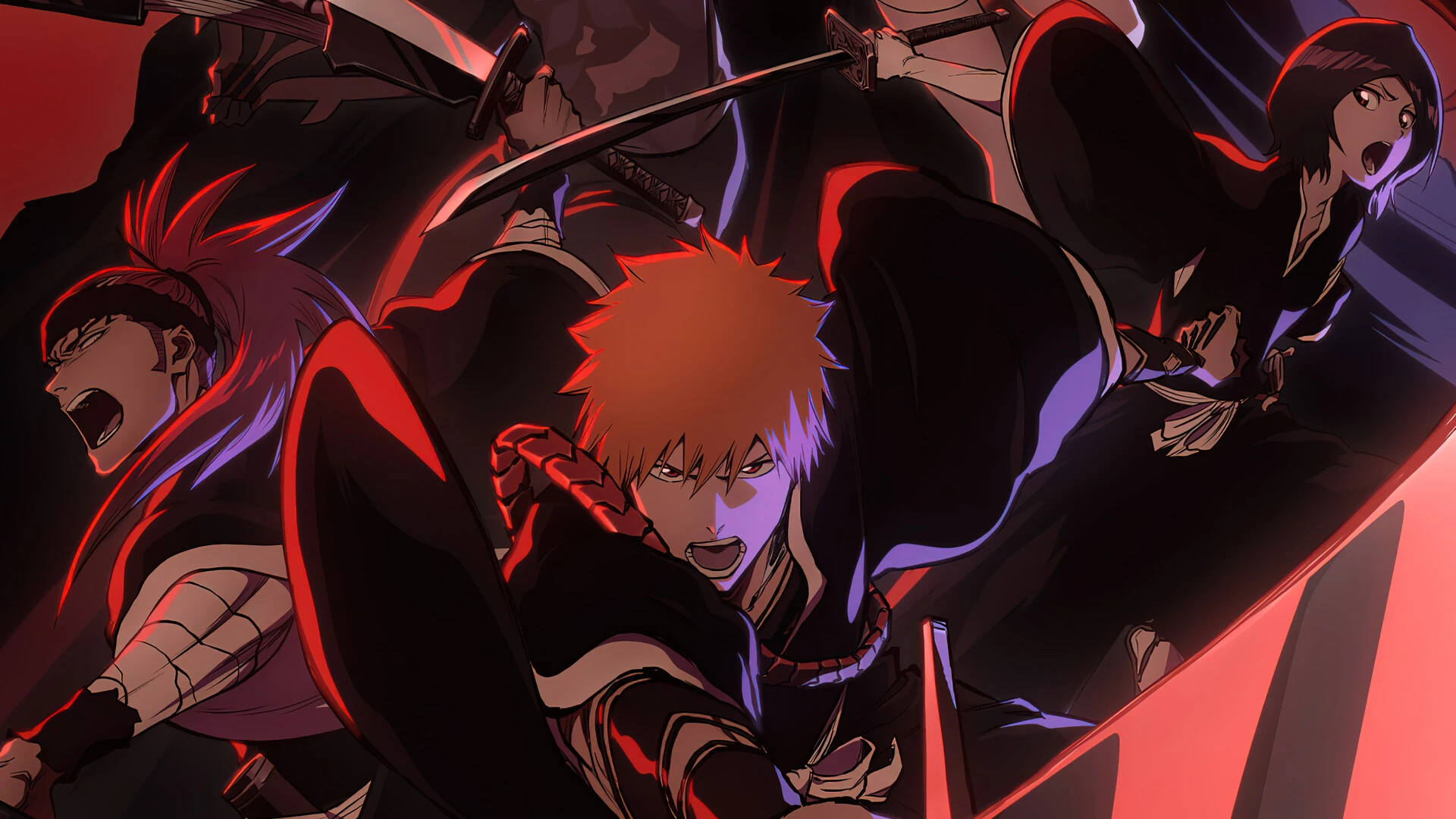
Bleach
The story of Ichigo Kurosaki, a teenager who gains the powers of a Soul Reaper — a death personification — and uses them to protect the living and the dead from evil spirits called Hollows, while uncovering a vast conspiracy that threatens both the human world and the afterlife.
Dragon Ball
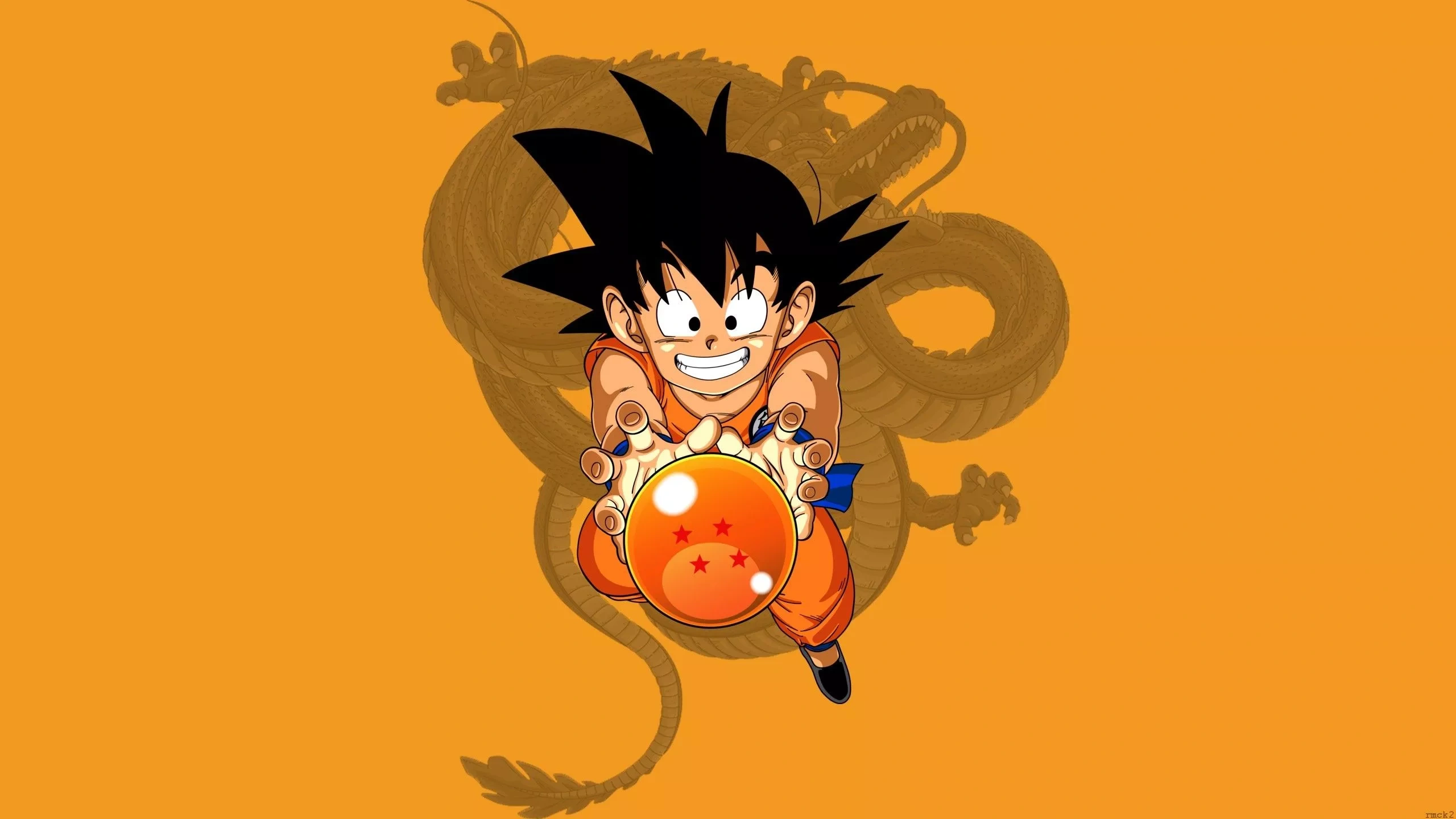
Follow Goku's incredible journey from a martial arts novice to Earth's mightiest defender in this action-packed adventure series.
Dragon Ball Z
Goku, Earth's greatest martial artist, discovers he is a Saiyan warrior sent from a dying planet. From defending Earth against Saiyan invaders to battles across the cosmos and ultimately against godlike beings, Dragon Ball Z defines the power-escalating battle manga genre.
Black Clover
An ongoing shonen fantasy magic manga following Asta, a young man without magic power in a world where magic dominates, as he pursues his dream of becoming the Wizard King through determination and friendship
Related Articles
All articles
Best Manga by Genre: The Ultimate 2026 Reading Guide (Shonen, Shojo, Seinen, Josei)
Comprehensive manga genre guide featuring best series by demographic and genre. From action shonen to mature josei, find your next read organized by taste and preference.
Weekly Shonen Jump Explained: How the World's Biggest Manga Magazine Works
Everything you need to know about Weekly Shonen Jump — history, ranking system, how manga gets serialized and canceled, famous series, and how to read it in English.

Shonen vs Seinen Manga: What's the Difference and Which Should You Read?
Understand the key differences between Shonen and Seinen manga. Compare themes, art styles, storytelling approaches with examples of each.